What Is Narrowband UVB Phototherapy?
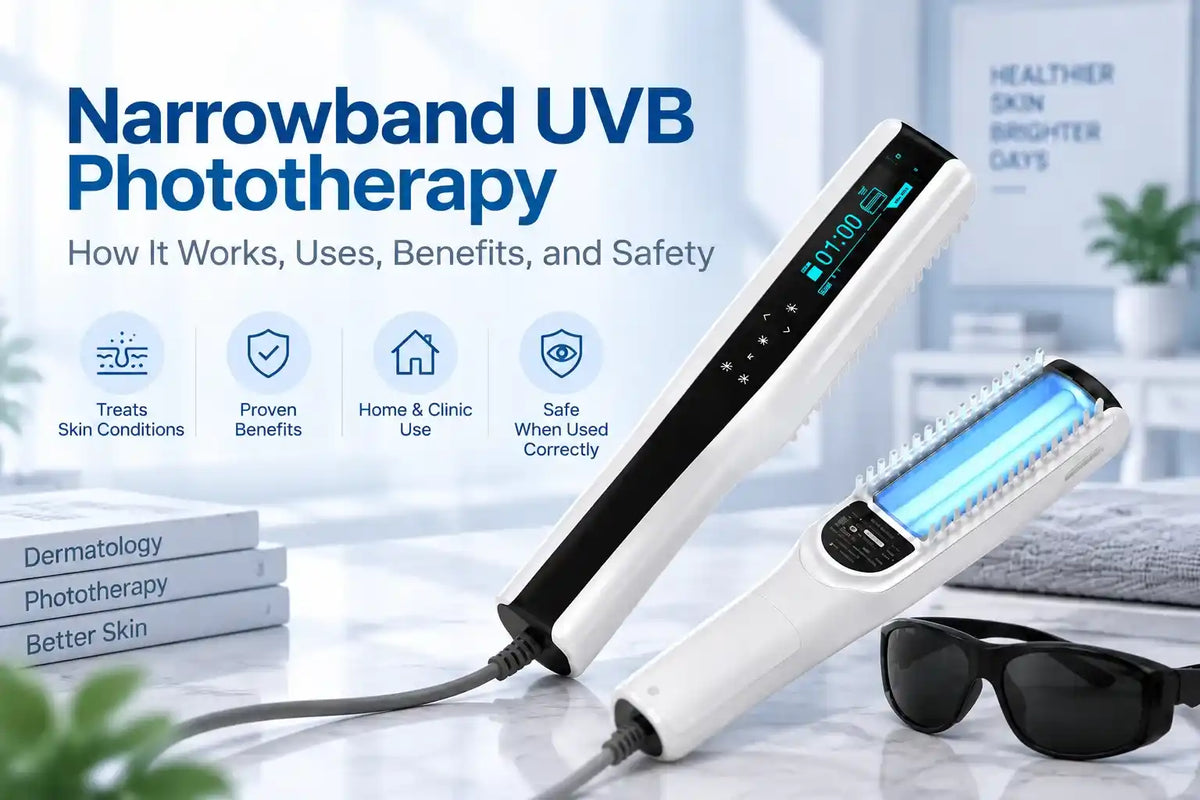
NB-UVB uses UVB light at about 311–313 nm. The name “narrowband” comes from this small range of wavelengths. TL-01 lamps, commonly used for this treatment, have their strongest output near 311 nm.
Why narrow the spectrum at all?
Because different wavelengths of UV light don’t behave exactly the same way in skin.
Broadband UVB exposes the skin to a wider section of the UVB spectrum. NB-UVB concentrates treatment around the wavelengths that have proved particularly useful in dermatology, allowing clinicians to deliver the treatment in a more controlled way.
The light doesn’t simply “dry out” a rash or tan the skin. Its effects go deeper than that.
The light affects immune activity in the skin and can ease inflammation. Redness, itching, and scaling may improve as a result. In psoriasis, UVB also slows the production of new skin cells, so they don’t build up on the surface as quickly.
Vitiligo is a different story. There, the goal is repigmentation. NB-UVB can support the activity and migration of remaining melanocytes—the cells responsible for producing pigment.
That’s why one type of light treatment can show up in conversations about several very different skin conditions.
When Is NB-UVB Used?
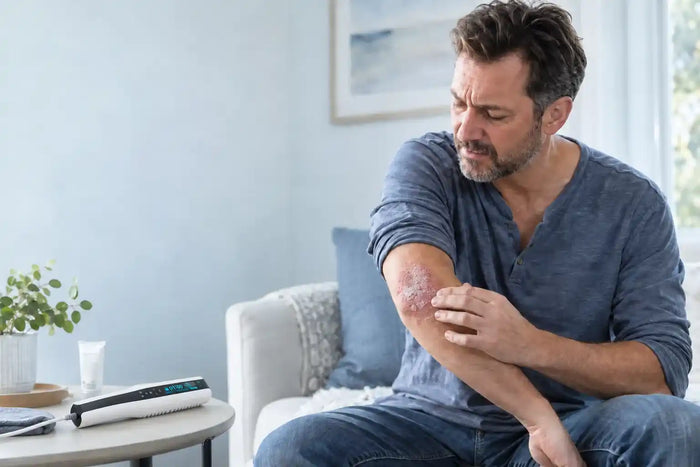
NB-UVB is most often used for psoriasis, vitiligo, and eczema. A dermatologist may also recommend it for early mycosis fungoides or certain conditions that make the skin unusually sensitive to sunlight. Whether it is suitable depends on the diagnosis, the areas involved, and how the skin has responded to other treatments.
The diagnosis alone doesn’t decide whether you need phototherapy. One small psoriasis patch may be easier to treat with a cream. When patches cover much of the body, applying cream to every area each day becomes more difficult. A full-body phototherapy unit can treat several areas together.
Vitiligo is another common example. NB-UVB may be used when repigmentation is the goal, especially when several areas of the body are involved.
Results aren’t uniform, though. A patch of vitiligo on the face may respond quite differently from one on the fingers or feet.
With atopic dermatitis, phototherapy is often considered when the condition is more widespread or hasn’t responded well enough to topical treatment alone.
So it helps to think of NB-UVB less as a treatment for one specific disease and more as a dermatology tool that can be used in several different situations.
What Does a Narrowband UVB Treatment Course Look Like?
Before starting treatment to treat your condition with narrowband UVB, your clinician will review your diagnosis, your current medications, previous treatment(s) and your history of
skin cancer. He/she will also ask about anything that could make your skin unusually sensitive to light.
Some clinics also use a minimal erythema dose (MED) test. A small area of skin is exposed to UVB to help estimate a suitable starting dose. The 2022 British phototherapy guideline recommends MED testing or testing a small area before beginning NB-UVB.
During each session, protective goggles are normally worn, and areas that do not need treatment may be covered. The first exposures are often brief. If the skin tolerates them well, the dose can be increased gradually. Redness that lasts longer than expected may mean the next session needs to be delayed or the dose adjusted.
Many treatment courses involve two or three sessions per week, although the schedule depends on the condition, treatment protocol and skin response. Missed sessions may also affect how the next dose is handled.
Results are usually gradual. Psoriasis plaques may become flatter and less scaly over time, while repigmentation in vitiligo can take longer to appear. There is no reliable number of sessions that guarantees a result for everyone.
NB-UVB vs. 308 nm: What’s the Difference?
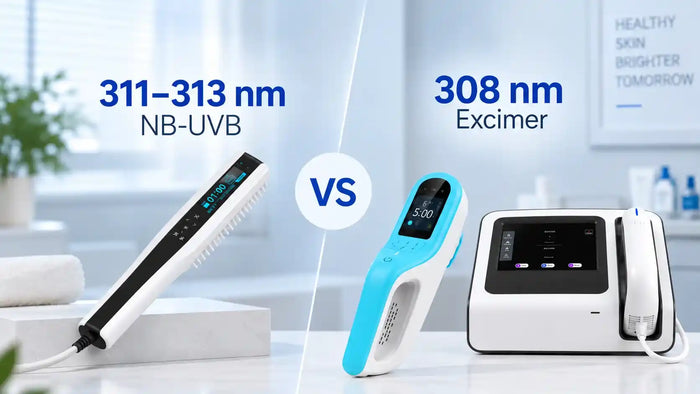
311–313 nm NB-UVB and 308 nm excimer therapy both use UVB light, but they’re usually used in different ways.
NB-UVB is well suited to treating larger or multiple areas. A patient may stand in a full-body cabinet, use a panel, or treat a broader section of skin.
A 308 nm excimer laser or lamp treats individual patches. The light is directed onto the affected skin, helping limit exposure around it. This can be useful when only a few areas need treatment and there is no reason to expose a larger area.
A simple way to picture it:
That doesn’t make one treatment universally “better.”
A person with widespread vitiligo and someone with two stubborn localized patches are dealing with very different treatment problems.
Studies comparing excimer therapy and NB-UVB in vitiligo also don’t support reducing the decision to a simple winner and loser. Treatment area, disease pattern, device type, schedule, and patient response all matter.
Think coverage versus targeting, rather than “old technology versus new technology.”
Clinic vs. Home NB-UVB
Clinic phototherapy usually means coming in several times a week. That may be manageable when the clinic is close to home. With a long drive, time off work, or childcare to arrange, a treatment that lasts a few minutes can take up much of the day.
That’s where home phototherapy can make a real difference.
Home treatment uses the same general idea—controlled NB-UVB exposure—but the patient performs the sessions at home according to a treatment plan.
The strongest recent evidence comes from the LITE trial, a U.S. study of 783 people with plaque or guttate psoriasis. Home NB-UVB was noninferior to office-based phototherapy for the study’s main patient- and physician-reported outcomes. People in the home group also completed more treatments, although persistent redness occurred more often with home treatment.
That last part matters.
Home treatment is more convenient. It isn’t automatically more forgiving.
A home plan still needs to address questions such as:
- How often should sessions happen?
- What happens after a missed treatment?
- When should the dose be held?
- What level of redness is too much?
- When should treatment stop until a clinician is contacted?
In other words, home phototherapy and self-directed phototherapy are not the same thing.
The BAD guideline recommends skin cancer checks at appropriate intervals after more than 500 whole-body NB-UVB treatments, especially for people with other risk factors. Keeping a treatment record helps the team track UV exposure over time.
Dose and Irradiance: Two Numbers That Are Easy to Mix Up
If you’ve compared phototherapy machines, you’ve probably seen numbers such as:
mW/cm²
and
mJ/cm²
They sound almost identical. They describe different things.
Irradiance tells you how intense the light is
Irradiance is usually written as:
mW/cm²
You can think of it as the amount of optical power reaching each square centimeter of skin at that moment.
A higher irradiance means energy is being delivered faster.
Dose tells you how much energy the skin actually receives
Dose is commonly written as:
mJ/cm² or J/cm².
It depends on both the intensity of the light and how long the exposure lasts.
The basic relationship is:
Dose = Irradiance × Time
For example, a measured irradiance of 10 mW/cm² delivered for 30 seconds equals 300 mJ/cm².
That’s simply the physics. It is not a suggested treatment dose.
This distinction is important because treatment time alone tells you very little.
Thirty seconds on one machine may not deliver the same UV dose as thirty seconds on another machine. Lamp output can differ, and output can also change over time.
That’s why professional phototherapy guidance puts so much emphasis on accurate dosimetry and regular irradiance measurement. The BAD guideline specifically recommends regular irradiance checks for phototherapy devices, including handheld equipment.
A stronger machine also isn’t automatically a “better” machine.
What matters clinically is delivering the intended dose accurately and consistently.
Is Narrowband UVB Safe?
 While Narrowband UVB is used daily in dermatology clinics, it is still a form of ultraviolet radiation and must be administered safely.
The most common response seen within a short period of time is that of erythema (reddening of the skin), similar in feel to mild sunburn. Occasionally patients report of dryness or itch, but more serious reactions such as painful redness or even blistering are seen with excessive exposure.
The full skin reaction may not appear immediately. UVB redness can develop several hours after treatment, so the response to one session may be used to decide whether the next dose should increase, stay the same or be reduced.
Cumulative exposure also matters. Phototherapy services usually record the number of sessions and previous treatment courses. The British Association of Dermatologists recommends reviewing skin-cancer risk after more than 500 full-body NB-UVB treatments, particularly in people who already have additional risk factors. This is a monitoring threshold, not a claim that skin cancer develops after a particular number of sessions.
Before treatment, tell the clinician about previous skin cancer, conditions that increase sensitivity to light, and any medicines or supplements you take. These factors can affect whether NB-UVB is suitable and what precautions are needed.
What Types of NB-UVB Devices Are Used?
There isn’t one standard shape for a phototherapy device.
What the equipment looks like usually depends on how much skin needs to be treated.
Full-body cabinets
These are the machines many people picture when they hear “phototherapy.”
The patient stands inside a cabinet surrounded by NB-UVB lamps. They make sense when psoriasis, eczema, vitiligo, or another condition affects large areas of the body.
Panels
Panels provide broader coverage without fully surrounding the patient.
They can be useful when a large section of the body needs treatment but a full cabinet isn’t necessary or practical.
Handheld units
A handheld device makes more sense when the treatment area is relatively small.
Instead of exposing most of the body, the light can be moved from one area to another.
Some home phototherapy systems use this format.
Comb-style devices
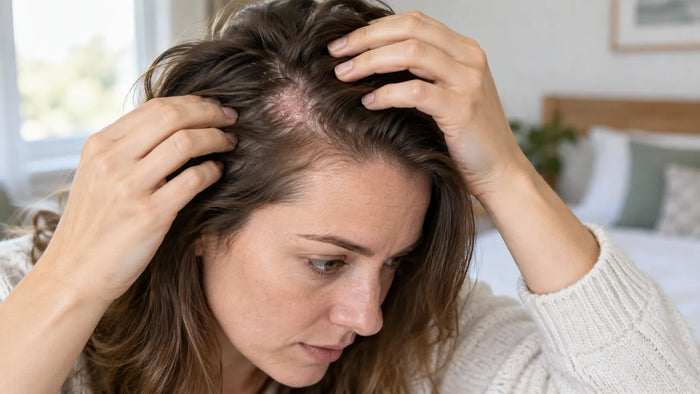
Hair creates an obvious problem when the scalp needs UV treatment: it blocks light from reaching the skin.
Comb attachments or comb-style phototherapy devices are designed to help separate the hair so UVB can reach the scalp more directly.
Targeted devices
This is where 308 nm excimer lamps and lasers fit in.
Rather than illuminating a large area, they deliver UV treatment to specific lesions or patches. Clinical guidelines distinguish these targeted light sources from the more common fluorescent NB-UVB systems used for broader treatment.
The format changes.
The basic safety issue doesn’t: the device has to deliver a known amount of UV in a controlled way.
Frequently Asked Questions
Is 311 nm the same as narrowband UVB?
311 nm sits right at the center of the wavelength range commonly associated with NB-UVB.
You’ll see NB-UVB described as 311 nm, 311–313 nm, or 311 ± 2 nm depending on the lamp, paper, or clinical convention being used.
Those descriptions are talking about essentially the same narrow therapeutic part of the UVB spectrum.
Is NB-UVB stronger than 308 nm?
That question mixes up wavelength and output.
311 nm and 308 nm describe wavelength, not how much light energy a device delivers.
The actual treatment also depends on irradiance, dose, exposure time, device design, and treatment area.
So a smaller wavelength number doesn’t automatically mean a “stronger” treatment.
How Often Will I Need NB-UVB Treatment?
Two or three sessions a week is common. Your clinic will set the schedule for your condition and review it as treatment continues. Let them know about missed sessions or redness afterward, since either may change the plan for your next treatment.
Can NB-UVB be used at home?
Yes. Home NB-UVB is an established option for selected patients.
The recent LITE trial provides strong evidence for home treatment in plaque and guttate psoriasis, but the treatment still needs an appropriate dosing and monitoring plan.
Does a higher irradiance mean faster results?
Not necessarily.
Higher irradiance means a device delivers energy more quickly. It doesn’t mean the skin should simply receive more UV.
The treatment goal is an appropriate dose, not the highest possible output.
Is NB-UVB the same as a tanning bed?
No.
Medical NB-UVB equipment is designed around a controlled therapeutic UVB spectrum and measured dosing.
Tanning beds are designed to produce a tan and generally use a different mixture of ultraviolet radiation. They aren’t a substitute for a prescribed phototherapy treatment.
Final Thoughts
NB-UVB uses light around 311–313 nm. Larger devices can treat widespread areas, while 308 nm excimer devices are usually better suited to individual patches.
Home and clinic treatments both need careful dosing. If the skin stays red or feels sore after a session, the next dose may need to be reduced or delayed.
References
- British Association of Dermatologists and British Photodermatology Group Guidelines for Narrowband UVB Phototherapy — 2022
- Guidelines on Measuring Ultraviolet Radiation in Phototherapy — 2015
- Home vs Office NB-UVB Phototherapy for Psoriasis — LITE Trial, 2024
- 308 nm Excimer Lamp Compared With Other Phototherapy Devices for Vitiligo — 2016
- An Update on Narrowband UVB Therapy for Skin Diseases — 2021