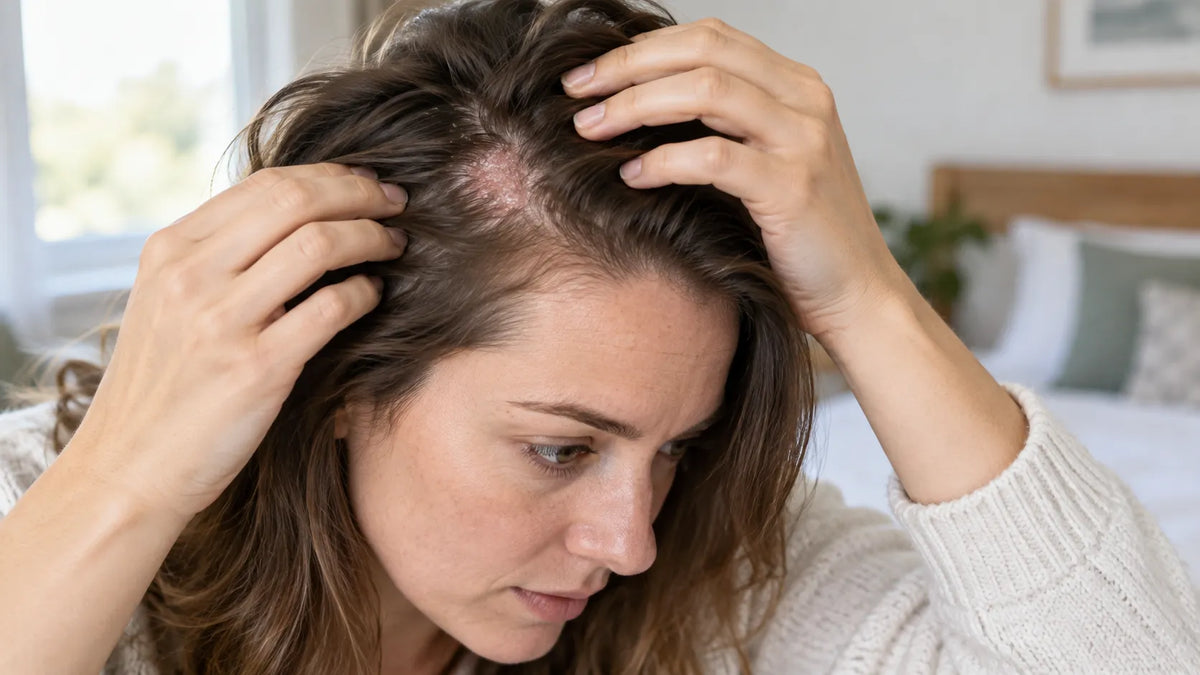
Hair is what makes scalp psoriasis awkward to treat with light. A spot near the hairline is pretty easy to get to. Once the patch sits deeper under the hair, though, it gets harder to see and harder to reach. Sometimes the hair simply gets in the way of the light.
The size and location of the patches matter too. One small spot near the hairline is much easier to treat than several patches around the top or back of the head. In some cases, simply getting the hair out of the way can be a bigger issue than choosing between 308 nm and 311 nm.
UVB phototherapy is already used for psoriasis, including narrowband UVB when creams and other topical treatments are not enough or are not a good fit. For scalp psoriasis, the real challenge is usually pretty simple: getting the light onto the skin and using a device that makes sense for the area you need to treat.
Why Scalp Psoriasis Is Harder to Treat With Light
Even when you know exactly where the plaque is, hair can fall back over it as soon as treatment starts. With longer or thicker hair, part of the light may be blocked before it reaches the scalp.

This is one reason comb-style phototherapy devices have been studied for scalp psoriasis. The comb helps separate the hair while bringing the light closer to the skin. A clinical study using a broad-band UVB fiber-optic comb found improvement in treated scalp areas. The important point is that the comb format helps with hair access; it is not the wavelength alone that solves the problem of hair blocking the scalp.
But hair is not the only thing that matters. Scalp psoriasis may show up as one patch near the hairline, a few spots around the crown, plaques behind the ears, or larger areas across the scalp. A small device may be very convenient for one or two spots and much less convenient if it has to be moved ten times during every session.
308 nm vs 311 nm for Scalp Psoriasis
There is no useful answer that says one wavelength is always better.
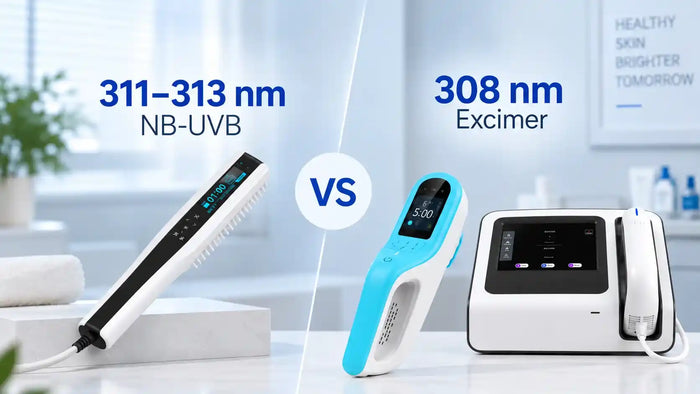
311 nm narrowband UVB has a long history in psoriasis phototherapy and is included in clinical guidelines. When it is delivered through a comb-style device, the comb can also help separate hair so the light reaches the scalp more directly.
308 nm treatment is more commonly used in a targeted way for localized plaques. Both 308 nm excimer lamps and 308 nm excimer lasers have been studied for scalp psoriasis, although they are different technologies and should not be treated as the same device.

The easiest way to think about it is this:
| 311 nm comb | 308 nm targeted treatment | |
|---|---|---|
| Main problem it helps with | Hair covering the scalp | Smaller, defined plaques |
| How it is used | Work through the hair section by section | Aim at selected treatment areas |
| Good fit for | Hair-covered scalp psoriasis | Localized or exposed areas |
| Main limitation | Larger scalp areas still take time | Many separate plaques mean more repositioning |
So instead of asking “Which wavelength wins?”, ask “What does the scalp actually look like?”
That usually gives a much more useful answer.
How Scalp UVB Treatment Usually Works
The first job is getting the treatment area clear. If the plaque is under the hair, the hair needs to be moved away. With longer or thicker hair, it is usually easier to work on one section at a time rather than trying to expose the whole scalp.
A comb can do some of that work while the device is being used. With a regular handheld treatment head, the area may need to be exposed first and then treated.
After one section is done, the device moves to the next area if needed.

The dose or treatment time should come from the treatment plan for that particular device. UVB dosing is not something that should be copied from another lamp just because the wavelength sounds similar. Clinical guidance recommends treatment protocols, testing for a safe starting dose, and regular checks of device output.
That is also why a higher number on a product page does not automatically mean better treatment. Output, distance, dose, and treatment area all work together.
Why Treatment Area Matters
Treatment area is one of the most useful things to look at when comparing scalp phototherapy devices, but it often gets buried under wavelength and power specifications.
Imagine one small plaque sitting near the front of the scalp. A targeted device may only need to be positioned once or twice.
Now imagine plaques around the crown, behind both ears, and at the back of the head. The same small treatment head may have to move over and over again.

The treatment itself may still work, but the routine becomes longer.
Treatment area is already an important part of phototherapy device selection, but scalp psoriasis adds another factor: hair access.
A small plaque hidden under dense hair and a small plaque along the hairline may be the same size, but they are not the same treatment problem.
Choosing a Scalp Phototherapy Device
For scalp psoriasis, wavelength is only part of the decision.
First look at the area you actually need to treat.
If the plaque is buried under hair, getting access to the scalp may be the biggest problem. If the plaque is small and exposed, a targeted handheld device may be easier. If the treatment needs to be more focused and repeated in a clinical setup, an excimer laser system may make more sense.

Before choosing a device, look at where the plaques are, whether hair covers them, how many areas need treatment, and whether you can reach them comfortably.
Treatment area, controls, output, and dosing features still matter, but the device first needs to be practical for the part of the scalp you actually want to treat. Hair falling back over the plaque, difficulty reaching the back of the head, and repeated repositioning can all make treatment more awkward. More UV is not the answer to a difficult treatment area, so treatment time should still follow the recommended plan.
This is also the main difference between the three UVBWell options.
| Scalp situation | UVBWell option |
|---|---|
| Plaques hidden under hair | UVBWell Luma Comb Handheld 311nm UVB Phototherapy Lamp at Home |
| Small or exposed areas that need targeted treatment | UVBWell Luma Flex 308nm Excimer Light Phototherapy Device |
| Targeted 308 nm excimer laser treatment | UVBWell Luma Station 308nm Excimer Laser System Phototherapy |

Rather than trying to make one device work for every situation, the range covers three different ways of treating a localized area.
When a 311 nm UVB Comb Makes Sense
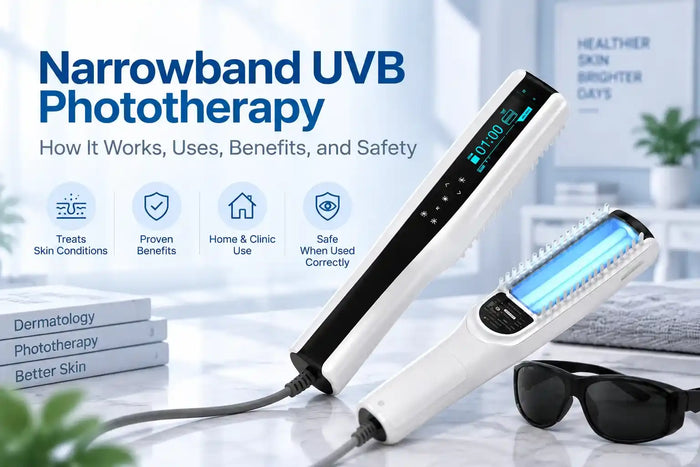
The UVBWell Luma Comb Handheld 311nm UVB Phototherapy Lamp at Home is the option designed around a problem that is very common on the scalp: the hair itself.
The comb helps move strands away from the skin while the light is being used. That can be much easier than holding the hair aside with one hand and trying to position the light with the other.
For someone with plaques sitting under the hair, that is a practical difference. Instead of shining light over the top of the hair, the user can work through the scalp section by section.
311 nm narrowband UVB has been used for psoriasis for a long time and is included in clinical guidance when topical treatment has not worked well enough or is not suitable. Scalp-specific research has also evaluated UVB comb delivery. These are separate points: narrowband UVB has established evidence in psoriasis, while the comb format helps deal with hair blocking the treatment area.
The comb format is what makes this product especially relevant to the scalp. A regular handheld light and a comb may use similar phototherapy principles, but the comb can make it easier to expose the skin when hair is covering the treatment area.
For a large scalp area, there is still some work involved. The comb has to move from section to section. But it solves a problem that a flat treatment head does not solve as easily: getting through the hair.
When a Handheld 308 nm Device Makes More Sense
Not every scalp plaque is hidden under thick hair.
Psoriasis can appear along the hairline, behind the ears, or in small areas where the skin is already easy to reach. In those cases, the comb may not be the main thing you need.
That is where the UVBWell Luma Flex 308nm Excimer Light Phototherapy Device fits in.
A handheld 308 nm device gives the user a more targeted way to work on a smaller area. There is less reason to cover a large part of the surrounding skin when the plaque itself is small and clearly visible.
Targeted 308 nm treatment has been studied for localized psoriasis, including scalp psoriasis. Research has specifically evaluated 308 nm excimer lamps for scalp psoriasis, so the evidence here does not rely only on excimer laser studies. A targeted treatment head can also limit unnecessary exposure of nearby unaffected skin.
The trade-off is simple: small-area treatment is convenient when there are only a few spots. If psoriasis is scattered all over the scalp, the device has to be repositioned again and again.
So the Luma Flex is not meant to “beat” a comb. It solves a different problem.
Where the Luma Station 308 nm Excimer Laser Fits
The UVBWell Luma Station 308nm Excimer Laser System Phototherapy is the third option, and it should be kept separate from the handheld Luma Flex.
Both use 308 nm, but one is an excimer light device and the other is an excimer laser system. They should not be described as if they are the same machine simply because the wavelength is the same.
308 nm excimer laser treatment has also been studied for psoriasis, including scalp psoriasis. Earlier scalp studies used hair-parting or hair-blowing attachments to help expose the skin before treatment, which again shows that hair access is a device-delivery issue rather than a wavelength issue alone.
For someone comparing products, this distinction is more useful than simply seeing “308 nm” twice on a specification sheet:
- Luma Comb: 311 nm comb format for getting through hair.
- Luma Flex: handheld 308 nm excimer light for smaller targeted areas.
- Luma Station: 308 nm excimer laser system for targeted laser treatment.
The three formats are designed for different treatment situations rather than being interchangeable versions of the same device.
Home Treatment or Clinic Phototherapy?
Home treatment can be more convenient simply because you do not have to keep going back to a clinic. For psoriasis in general, research has shown that home NB-UVB can work about as well as treatment done in a clinic. That study was not focused on scalp psoriasis, though, and the scalp has its own problems. Hair can cover the spot, and areas around the crown or back of the head can be hard to see and reach.
A handheld light or comb can make those areas easier to work with at home. Some people are comfortable doing that themselves. Others may prefer clinic treatment, especially when the spot is difficult to reach or the dose still needs to be adjusted. Either way, home treatment should follow the treatment plan rather than changing the time or dose on your own.
When Light Therapy May Not Be Enough
Light therapy often comes later. At first, people are usually trying shampoos, foams, gels, or liquid treatments because they are easier to use around the hair. If one of those is keeping the scalp under control, there may be no reason to add UVB.
If it is not helping enough, UVB may be worth discussing. But longer sessions are not always better. If the scalp keeps getting red or sore and the patches are not really changing, the treatment may need another look. It could be the dose, the way the light is being used, or simply that another treatment would make more sense.
FAQ
Does UVB light therapy work for scalp psoriasis?
UVB phototherapy is used for psoriasis, including scalp psoriasis. The main challenge is getting enough light past the hair and onto the affected skin.
Can UVB get through hair?
Hair can block some of the light. Parting the hair or using a comb-style device can help expose the scalp so the UVB reaches the treatment area more directly.
Is 308 nm or 311 nm better for scalp psoriasis?
There is no simple winner here. A 311 nm comb is handy when the patches sit under the hair because the comb helps clear a path to the scalp. A 308 nm device is often easier to use on a small spot that is already easy to see and reach. So it really comes down to where the patches are and how easy they are to treat.
Can scalp psoriasis light therapy be done at home?
Home phototherapy is an option for some people, but it should be used with an appropriate treatment plan and medical guidance. The device also needs to be practical for the part of the scalp being treated.
Final Thoughts
Scalp psoriasis can make phototherapy more difficult because hair often gets between the light and the skin. That is why the treatment area and device design matter as much as the wavelength.
UVBWell offers different options for different situations: the Luma Comb for hair-covered scalp areas, the Luma Flex for smaller targeted areas, and the Luma Station for targeted 308 nm excimer laser treatment. The best place to start is with the scalp itself—where the plaques are, how much area needs treatment, and how easy they are to reach.
References
-
Phototherapy for Psoriasis — National Psoriasis Foundation, 2025.
-
Guidelines for Narrowband UVB Phototherapy 2022 — Goulden V, Ling TC, et al., 2022.
-
Broad-band UVB Fiber-Optic Comb for the Treatment of Scalp Psoriasis — Taneja A, et al., 2004.
-
308-nm Excimer Lamp in Patients With Scalp Psoriasis — Rattanakaemakorn P, et al., 2021.
-
A 308-nm Excimer Laser for the Treatment of Scalp Psoriasis — Taylor CR, Racette AL, 2004.
-
Home- vs Office-Based Narrowband UV-B Phototherapy for Psoriasis — Gelfand JM, et al., 2024.