When people start looking for a home UVB phototherapy device, the first question is often:
“Which device is the best?”
But that is usually not the most useful place to start.
The better question is:
“Which device fits the areas I actually need to treat?”
A device that works well for a few small patches may become frustrating if you need to treat multiple areas across your body. A compact handheld unit may be convenient to store, but it may not be the easiest option if you need to reach your back or treat a larger area.
Choosing a UVB phototherapy device is less about finding the biggest, newest, or most powerful machine. It is about matching the device to your treatment needs, your body location, and your ability to use it consistently.
Before comparing products, consider five practical questions:
- How much skin needs treatment?
- Where are the treatment areas?
- Can the light reach the skin properly?
- Do you need targeted treatment or broader coverage?
- Can you safely and comfortably use the device at home?
Once your dermatologist has confirmed that UVB phototherapy is appropriate for you, these questions can help you compare devices more confidently.
Start With the Skin You Need to Treat
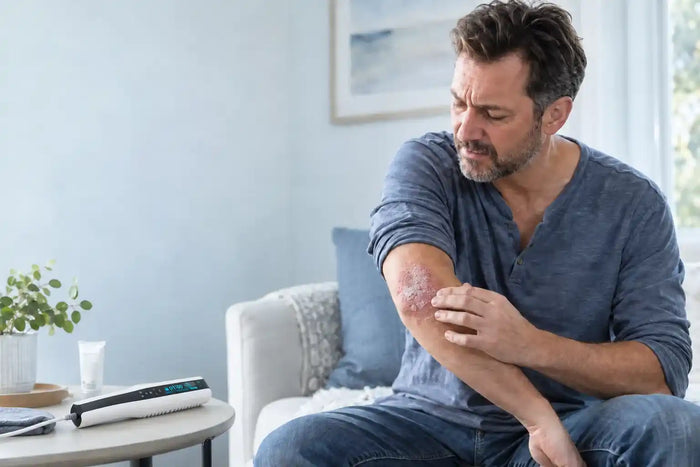
Before comparing devices, make a simple note of where your patches are, roughly how large they are, and how many separate areas would need attention.
You do not need a precise calculation to start this conversation. “Two small patches on my forearms” tells you something quite different from “several areas across my back and legs.”
| Your treatment situation | What to compare first | The practical issue to consider |
|---|---|---|
| A few small, accessible patches | Treatment window and ease of positioning | Can you position the device accurately over each area? |
| Several scattered patches | Coverage per exposure and repositioning | How many separate positions would a complete session involve? |
| A larger continuous area | Effective treatment area and available device formats | Would a small window make treatment unnecessarily time-consuming? |
| Scalp skin beneath hair | Comb attachment and access to the scalp | Can you move the hair aside and reach the intended skin? |
| Areas you cannot easily see or reach | Applicator design, positioning, and assistance | Could you use the device consistently, or would you need help? |
Count the patches as well as their size
A few scattered patches may cover little skin overall, yet still require several separate exposures. You may need to reposition the device, check its placement, and keep track of which areas you have treated.
That is why the effective treatment area matters. This is the area the device is designed to expose under its specified operating conditions. It is not the same as the size of the housing or the dimensions of the entire lamp.
When reviewing a product page, look for a clearly stated treatment window. If the description only says “large coverage,” ask for the dimensions.
Consider severity separately
More severe symptoms do not automatically call for a higher-output device or a more expensive model.
Severity helps your clinician decide whether phototherapy is suitable and how it fits into your wider treatment plan. Your medical history, previous response to treatment, and medicines also matter.
For psoriasis specifically, the American Academy of Dermatology describes phototherapy options for both localized plaques and more extensive disease. Our guide to psoriasis light therapy explains how these approaches fit into treatment.
Match the Device Format to Your Routine
Product descriptions often mix together several different things.
“Handheld” describes the format. “311 nm” describes the wavelength. “Home use” describes the intended setting. None of these, on its own, tells you whether a device will be practical for your treatment areas.
| Device format | What it offers | What to check before buying |
|---|---|---|
| Handheld NB-UVB | A compact format for localized treatment | Treatment window, weight, grip, and the number of positions needed |
| Comb-style NB-UVB | An attachment that helps separate hair for scalp access | Comb design, positioning instructions, and ease of reaching the scalp |
| Targeted 308 nm device | UVB delivery to selected patches | Applicator size, controls, and access to each treatment site |
| Larger NB-UVB panel | A wider treatment field | Space, treatment distance, positioning, and shielding requirements |
| Full-body NB-UVB system | Broad coverage for an appropriate treatment plan | Installation, supervision, operating requirements, and available space |
A tabletop device does not necessarily treat a larger area than a handheld one. A base unit may contain the controls while a separate applicator still delivers light through a relatively small window.
Compare the part that treats the skin, as well as the machine that sits on the table.
Think through an entire session
It is easy to focus on the advertised exposure time. Your routine also includes setting up, putting on protection, positioning the device, moving between areas, and recording the session.
Imagine doing those tasks on an ordinary weekday.
Can you read the display while holding the device in position? Is the stop control easy to reach? Would your arm become uncomfortable when treating the back of your scalp? Is there somewhere convenient to store everything afterward?
A demonstration with the device switched off can help you assess handling. It cannot establish treatment settings, but it can reveal an awkward grip or an area you cannot comfortably reach.
How UVBWell Devices Fit Into These Categories
If you’re browsing the UVBWell range, start by comparing how each device would fit the areas you need to treat. The three options below cover different device formats. Your clinician’s advice can help you narrow down which approach is appropriate.

| Compare | UVBWell Luma Comb | UVBWell Luma Flex | UVBWell Luma Station |
|---|---|---|---|
| Light type | 311 nm NB-UVB | 308 nm excimer | 308 nm excimer |
| Device format | Handheld with comb attachment | Handheld | Tabletop with separate applicator |
| Design focus | Localized treatment and scalp access | Targeted treatment of individual patches | Targeted treatment with a separate handpiece |
| Handling to consider | Parting hair and reaching the scalp | Holding and repositioning the device | Positioning the base unit and reaching treatment sites |
| Before choosing | Check comb positioning and treatment coverage | Check treatment-window size and grip | Check workspace and professional-use requirements |
Before deciding, compare the current specifications and instructions for each model, including its treatment area, controls, protective accessories, and servicing requirements.
For Scalp Treatment, Check How the Light Reaches the Skin
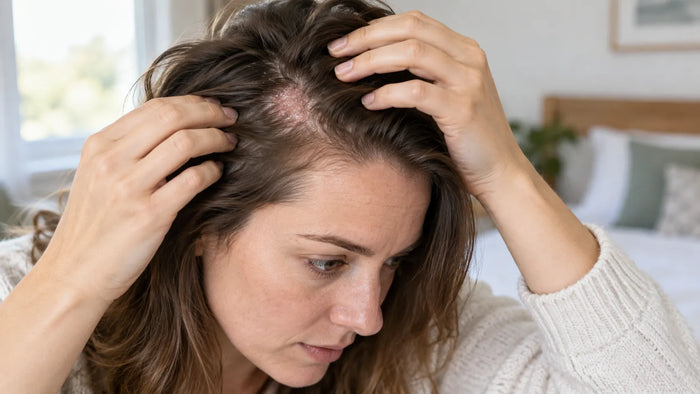
Scalp treatment has a practical obstacle: hair can block UVB from reaching the skin.
A patch near an exposed hairline may be fairly easy to access. An area beneath thick hair at the crown can be much harder to see and position a device over.
Comb-style attachments help separate the hair and position the light source near the scalp. They do not make UVB pass through hair, and they do not remove the need to follow the device’s positioning instructions.
Before choosing a scalp device, consider:
-
Whether you can part the hair around the treatment site.
-
How comfortably you can reach the crown and back of your head.
-
Whether you can maintain the required position.
-
Whether someone would need to help you.
Do not extend exposure on your own to compensate for hair blocking the light. If access is difficult, ask your treatment team to show you how to position the device.
To see what a comb-style device looks like, take a look at the UVBWell Luma Comb. When reviewing it, pay attention to the comb attachment, positioning instructions, and how easily you could reach the areas beneath your hair.
For more on this issue, read Scalp Psoriasis and UVB Light Therapy: What to Know.
Decide Whether You Need Targeted Treatment or Broader Coverage
Targeted phototherapy directs light onto selected areas and can limit exposure of surrounding unaffected skin. This may be useful when individual patches need treatment.
The practical trade-off is coverage. A small window may be straightforward to position over two patches, but treating many separate areas means repeating that process.
Larger NB-UVB systems can expose more skin at once, although more surrounding skin may also be within the treatment field.
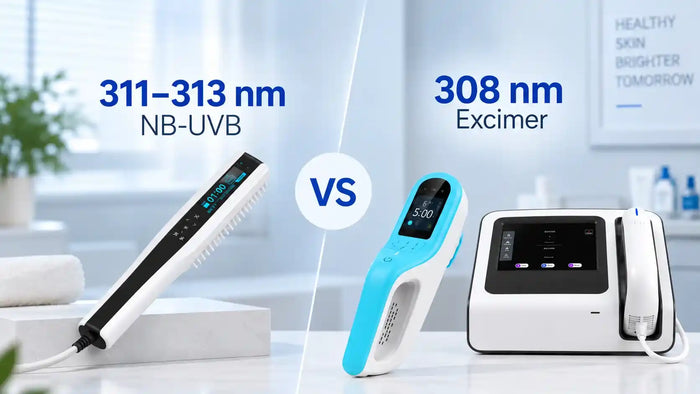
There is some overlap between these categories. Localized NB-UVB devices exist, so a small patch does not automatically require a 308 nm device. Likewise, “308 nm” does not tell you whether the light comes from an excimer lamp or a laser.
A useful question for your clinician is:
“For my treatment areas, how important is it to limit exposure of nearby skin, and would a wider treatment field be more practical?”
Our comparison of 311 nm NB-UVB and 308 nm excimer light explains these differences in more detail.
Check Whether Home Treatment Is Practical for You
Home phototherapy can reduce travel and make repeated treatment sessions easier to fit around work or family life. It also means taking responsibility for tasks that clinic staff would otherwise help manage.
DermNet emphasizes that home phototherapy should involve medical supervision. Before buying, confirm that your clinician supports home treatment and that the specific device is intended for that use.
You should know how your treatment plan will be provided, how follow-up will work, and whom to contact if your skin reacts unexpectedly. Product support can explain equipment controls and accessories; dose decisions belong with your treating clinician.
Make sure you can follow the routine
Consider whether you can read the controls, position the device consistently, keep a treatment record, and recognize when you need help.
Your treatment team should explain the required eye protection and any shielding of untreated skin. Ordinary sunglasses should not be assumed to provide the protection required for UVB treatment.
Ask what to do after missed sessions and whether changes to medicines or skin products affect your plan. If you develop painful or persistent redness, blistering, or a burn, pause treatment and contact your clinician before another exposure.
The British Association of Dermatologists’ patient guidance covers these precautions and the importance of reporting changes during a course of treatment.
For a broader introduction, see our narrowband UVB phototherapy guide.
Compare Specifications You Can Actually Verify
Once you have narrowed down the format, ask for the manual and written specifications for the exact model you are considering.
Photos can help you judge the layout. They cannot tell you how output is measured, how a dose setting works, or what maintenance the device requires.
| Specification | What to ask |
|---|---|
| Wavelength and light source | What type of UV source does this exact model use? |
| Effective treatment area | What are the treatment-window dimensions under the specified operating conditions? |
| Irradiance | What output reaches the skin, and at what distance was it measured? |
| Time or dose controls | Does the device control time, dose, or both? How is the displayed dose determined? |
| Positioning | Is a particular distance, spacer, or contact position required? |
| Output checks | How is output checked, and when is servicing or calibration needed? |
| Intended use | Is the model intended for home use, professional use, or both in your market? |
| Parts and service | Which components need replacement, and who supplies and services them? |
Understand what the numbers mean
Three terms are especially useful when comparing specifications:
Wavelength, measured in nanometers, describes the UV light.
Irradiance, commonly measured in mW/cm², describes the UV power reaching a given area of skin.
Dose, commonly measured in mJ/cm² or J/cm², describes the UV energy delivered per unit area during an exposure.
At a constant irradiance, dose depends on both output and exposure time. A higher-irradiance device can deliver a given dose more quickly, but that does not establish better treatment results or justify increasing the prescribed dose.
Compare output figures only when the measurement conditions are clear. A value measured at one distance may not be comparable with a value measured at another. Electrical wattage is also different from UV irradiance at the skin.
If a device displays dose, ask whether it measures output during treatment or calculates the value from stored output information. Understanding that distinction helps you ask the right questions about output checks and maintenance.
Look beyond certification badges
The FDA explains that registration and listing do not, by themselves, mean a device has been approved or cleared.
If a seller makes a regulatory claim, ask for documentation tied to the exact model and manufacturer. Check that it applies to your country and the intended use.
A general badge or the ability to ship a device internationally does not answer those questions.
Look Beyond the Purchase Price
The cost of owning a device includes more than the checkout total.
Ask which accessories come with it, what replacement parts cost, and how repairs are handled. If the unit needs service, where does it go? Who pays for shipping? What does the warranty cover?
Maintenance also varies by light source. A fluorescent NB-UVB unit and an excimer system may have different replacement and servicing requirements. Get details for the specific model.
If you hope to use insurance, confirm eligibility and any authorization requirements before ordering. Do not assume that coverage for phototherapy includes every device or seller.
Space matters too. A larger system needs a suitable treatment area, while a tabletop unit needs a stable surface and room for the applicator. Even a small handheld device needs safe storage.
Before purchasing, you should be able to say:
-
My clinician has confirmed that phototherapy is appropriate.
-
I know which areas are included in my treatment plan.
-
I understand how the device would be positioned over those areas.
-
I have reviewed the model’s instructions and specifications.
-
I know how to get treatment guidance and technical support.
-
I understand the likely accessory, maintenance, and service costs.
If a product detail is missing, ask the supplier before ordering. Dimensions, included accessories, controls, and setup requirements are all worth clarifying.
Frequently Asked Questions
Can a handheld UVB device treat several separate areas?
It may be practical for several areas, depending on the treatment plan and device. The main handling question is how often you would need to reposition it and whether you can reach each site comfortably. Consider the whole session rather than exposure time alone.
Do small patches always require a 308 nm device?
No. Localized NB-UVB can also be used for small areas. Your clinician can help determine the appropriate approach based on your condition, treatment history, and the areas involved.
Do I need a comb attachment for scalp treatment?
A comb attachment can help when hair blocks access to the scalp. Whether you need one depends on the location of the patches, hair coverage, and the equipment being used. Ask for positioning guidance before starting.
Does higher irradiance mean better treatment results?
Not necessarily. Higher irradiance can shorten the time needed to deliver a particular dose. Treatment results also depend on the condition, treatment site, prescribed protocol, and skin response.
Do I need a prescription for a home UVB device?
Prescription requirements depend on your country and the device. Check the exact model’s requirements with your clinician and supplier before purchasing. Home treatment still needs an appropriate medical plan and follow-up.
Compare Your Options
Once you know which areas need treatment and what your clinician recommends, it becomes easier to compare actual devices.
Explore the UVBWell phototherapy range to review device formats, treatment windows, and available controls. If you have questions about a model’s dimensions, accessories, or setup, contact our team before ordering. For advice on whether phototherapy is suitable for you or how to set your treatment dose, speak with your clinician.
References
-
Psoriasis Treatment: Phototherapy — American Academy of Dermatology.
-
Home Phototherapy — Anoma Ranaweera, DermNet, 2013.
-
SolRx UVB Home Phototherapy Selection Guide — Solarc Systems.
-
Targeted Phototherapy — Anoma Ranaweera, DermNet, 2013.
-
Excimer 308-nm Laser Treatment — Vanessa Ngan, 2006; updated by Carolina Cordoba-Rincon and Monisha Gupta, DermNet, October 2016.
-
Phototherapy — NB-UVB — British Association of Dermatologists, updated June 2022.
-
Are There “FDA Registered” or “FDA Certified” Medical Devices? How Do I Know What Is FDA Approved? — US Food and Drug Administration.